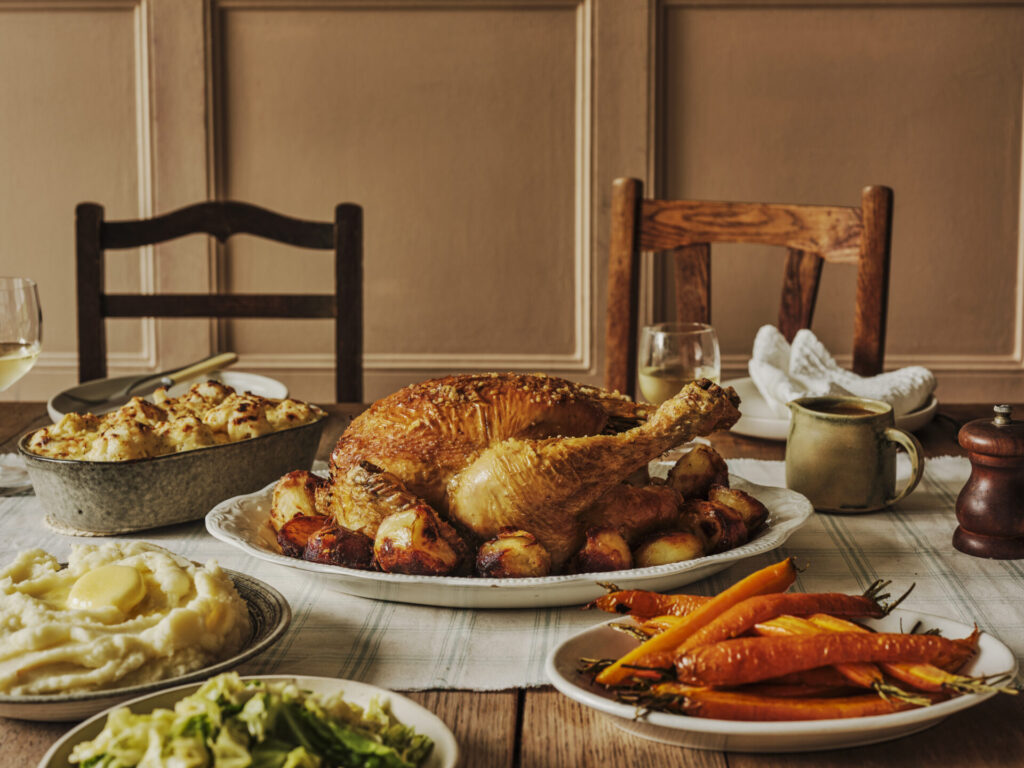
Not Your Average Chicken
The Ginger Pig 100 Day Chickens are a cross between a Cornish Game cockerel and a Sussex or Dorking hen. They are reared by father and son team Gerald and Richard Botterill on Lings View Farm on the Belvoir Estate. These birds are slow grown and feed on a completely natural diet of homegrown cereals plus the grass and herbage of their surroundings.
They free range on pasture during the day and are only brought inside at night to protect them from prowling foxes. What’s different to other free range birds is that they are reared to around 100 days, up to 2-3 times longer than commercial birds.
How 100-Day Chickens are Reared
A chicken reared for the table was, until relatively recently, considered an extravagance – something for special occasions or those of privilege. There were many who kept a few chickens at home, but this was solely for egg production, so any bird that made it into the kitchen was a spent laying hen or tough cockerel. This was in part due to our reliance on eggs, but until the genetic tinkering that started in the ’50s, chickens grew slowly and naturally, and the grain needed to fatten them for roasting was considered too precious.
The industrial hybridisation and mechanisation within the poultry farming industry has left the poor chicken in a sorry state, with the majority of poultry producers having moved onto a fast-growing, bland bird. We wanted to change this and bring back traditional rearing methods.
As with everything we do, we wanted to bring our customers the very best poultry to be bought in the UK today. A slow grown, carefully bred bird will produce significantly tastier, more succulent meat. This is because it has had a chance to grow to full maturity and develop a layer of fat under the skin. This renders down beautifully when cooking. Essentially, you can be sure that the care and attention given to the bird in life is reflected in its eating qualities.
Why is dry plucking better than wet plucking?
Our 100 Day birds are dry plucked by hand. Botterill’s Farm is one of the few producers in the UK who still carry out this labour intensive process. So why does it make a difference?
Wet plucking is a process by which the birds are dipped into simmering water to make removal of the feathers easier. This can make the skin clammy and produce an off-putting smell. This is how more than 99% of chickens sold in the UK are prepared.
Dry plucking, on the other hand, is a more complex and arduous process but one which yields much better results. The feathers are ‘waxed’ off by hand (as humans can with hair!), which leaves the skin very soft and almost velvety, with no lingering smell. This creates a good surface for seasoning, and also limits the amount of moisture trapped under the skin which would otherwise leave your roast a little limp and soggy.
Dry plucking also has the advantage of an increased ‘shelf life’ in comparison to wet-plucked birds, as the heat and moisture involved in wet plucking accelerates the growth of bacteria.
How to cook a 100-Day Chicken
Due to the amount these birds move around, they develop strong, muscular legs with a good ratio of breast meat. They therefore need to be cooked longer than a normal chicken. Roast or pot roast at a low temperature – we suggest 160°C – for two to three hours with a little liquid at the bottom of the roasting tray or pot. They are exceptionally succulent when cooked this way, and you’ll get a truly brilliant stock from the carcass.