The Life of a Lamb
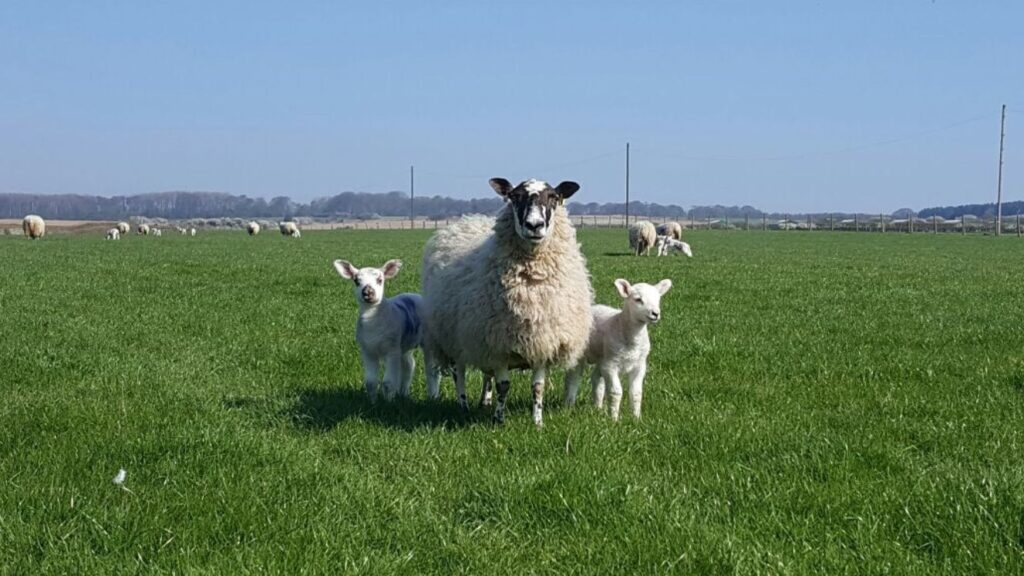
The majority of lambs in the UK are born between March and April. Ewe’s will only take the tups (the rams) at certain times of the year when the season is appropriate to raise their lambs. Lambs are born when fresh grass grows – the mothers can graze in abundance on the green land and thus producing lots of creamy milk to feed her little ones – lots of milk means for healthy lambs. New season lambs when born in April stay ‘new season’ until 31st December. The name only changes to Hogget in their second calendar of life and so by January it changes to said Hogget, where the meat becomes denser, the colour deepens and texture, heavier. This is of course, still absolutely delicious and simply needs a lower and slower cooking technique compared to the lighter spring lamb.
In Tim’s opinion, lambs should be born in spring and ready for slaughter around August, this is known as ‘new season lamb’. However, man likes to mess with nature. A breed of sheep known as the Dorset Sheep have the ability to be in season all year round due to the weather in the south being a lot milder. The grass is healthier and greener for a much longer time of the year compared to anywhere else in the UK. Virtually all lamb eaten at Easter comes from the south – Dorset, Cornwall etc. The Dorset ewe takes the tup around March through to May, with a five month gestation period. Lambs are then born around September and spend the next six months feeding to get them ‘to size’, perfectly in time for the following year’s Easter celebrations. This is known as ‘late-born lamb’ and has all the same characteristics of typical spring lamb; mild in flavour, a blushing pink colour and a wonderful, tender texture when eaten.
100 years prior to present day, hogget was traditionally eaten at Easter due to the natural seasonality as stated previously. It then moves into the mutton stage as it ages. Hogget and mutton are bigger and heavier in texture, delicious nonetheless but many people often get confused or simply don’t know the difference in these three stages of a lamb’s life and so treat it all the same way when cooking. Hogget or mutton must be gently cooked for a longer period of time on a lower heat. Traditionally, the legs would be cooked in sauces with capers or white onions. Shoulders were wonderful in stews such as the famous Lancashire hotpot, gently braised on the bone. Farmers would check to see the age of sheep when attending sheep markets by inspecting their mouths – sheep tend to loose their teeth as they age and so by seeing the amount/lack of teeth, the farmers would know the age of the animal and make a decision to buy or not mainly based on this. No teeth meant an old sheep which was deemed no longer good enough to breed and so was taken to slaughter to be eaten as mutton. After hogget, sheep become mutton which only comes from ewes – this tends to be after the ewe has had two issues of lambs.
Sheep were traditionally known as ‘Hogs’ or Jumpdykes’. A dyke is a water way which separates fields, sheep were known to jump over the dykes to enter the next field, hence the name ‘Jumpdykes’.